Community Bank Value Screener
Challenge
Small-cap community banks are one of the last genuinely under-covered corners of the public markets. There are hundreds of listed names below a billion dollars of market cap, most followed by no sell-side analyst, many trading below the tangible book value of their equity. The signal is there in the regulatory data — every bank files a quarterly Call Report with the FFIEC, and every issuer files capital, insider, and buyback activity with the SEC — but it lives in a dozen incompatible formats, and the moment you turn it into a “score” you risk fooling yourself with an opaque black box.
The job was to build a screen that is genuinely useful and genuinely inspectable: one where every name that surfaces can be traced back to the exact regulatory filing that put it there.
Solution
A rules-based screener that joins FFIEC Call Report fundamentals, SEC EDGAR issuer facts, and Polygon pricing into a single auditable pipeline, then applies seven hard gates and a weighted opportunity score.
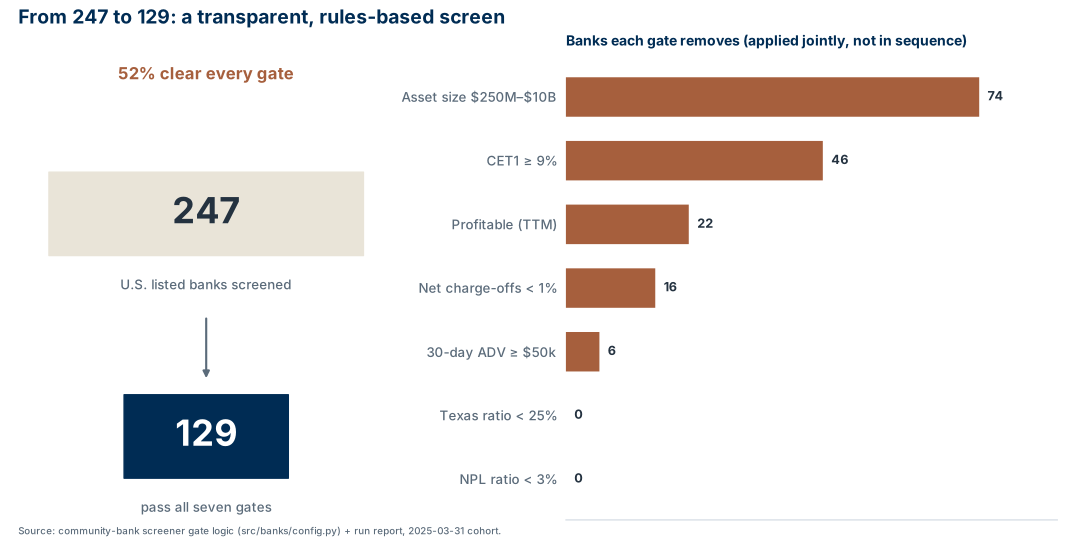
The gates are deliberately boring — capital adequacy, credit quality, profitability, tradability, and size — and they are applied jointly, not as a marketing funnel. On the most recent cohort, 247 listed banks went in and 129 cleared every gate.
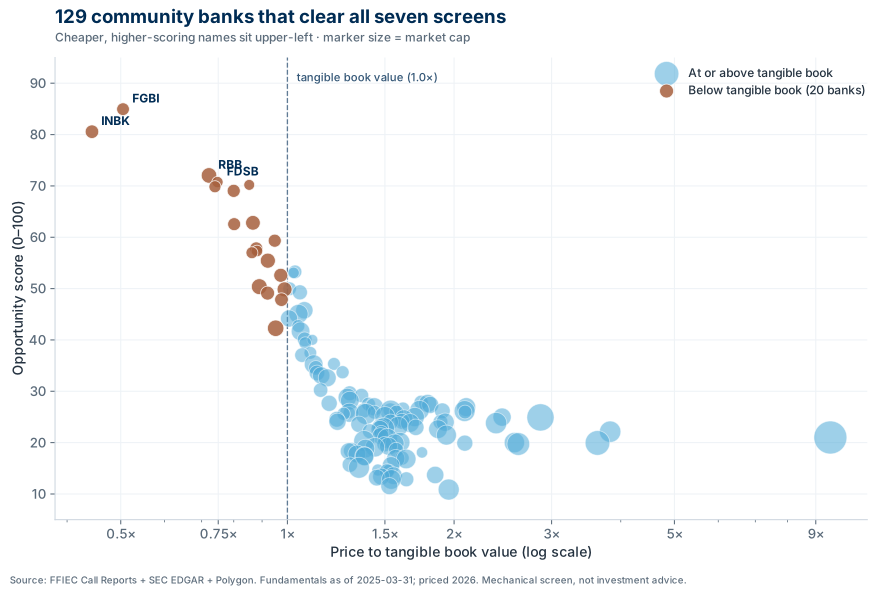
The 129 survivors are then ranked by a transparent 0–100 opportunity score weighted toward the things that actually matter for a value buyer: price-to-tangible-book (the anchor), upside to private-market takeout multiples, profitability (ROA), capital strength (CET1), credit quality, an “overlookedness” bonus for the smallest names, and a small kicker for genuine insider buying. Plotting the survivors makes the opportunity set legible at a glance:
Everything is reproducible from the raw filings: the gate thresholds live in version-controlled config, the score weights are explicit, and the output carries per-name risk flags (extreme discount, elevated uninsured deposits, CRE concentration, near-gate credit) so nothing hides behind a single number.
Impact
The screen turns hundreds of unfollowed banks into a focused, ranked short list that a human can actually underwrite — without outsourcing judgment to a black box. It is the sourcing layer for deeper, by-hand memos, where each candidate is checked against primary FFIEC and SEC filings before anything moves forward.
It is, deliberately, a mechanical screen and not investment advice. The fundamentals shown here are an as-of 2025-03-31 Call Report cohort priced into 2026, the takeout-upside marks are valuation arithmetic rather than acquisition forecasts, and a passing score is the start of diligence, not the end of it. The point is the discipline: a repeatable, fully auditable way to find the twenty or thirty names worth a closer look, with the receipts attached.