Pressure-Testing a Treasury Strategy to Death
Challenge
Most published backtests are flattering, because the person running them wants the strategy to work. The hard part of quantitative research is not finding something that looks good — it’s being the one who tries hardest to break your own idea before any real money touches it.
This is a case study in exactly that. I built a systematic strategy trading the U.S. Treasury futures curve (ZT/ZF/ZN/ZB) — butterfly relative-value plus carry-and-roll — and ran it walk-forward, out-of-sample, across 33 years (1993–2026). The early results looked promising: a walk-forward Sharpe in the low-0.8s, profitable in the large majority of years, and tens of thousands of dollars of simulated profit on a small seed. It would have been easy to write that up as a win.
Solution
Instead, I kept attacking it. The decisive test was trade booking. A butterfly is a three-leg package, but the original backtest had been booking each fly as if it were a single outright position — which quietly mispriced the carry and the execution. When I re-booked every trade as a true 3-leg package (the way it would actually fill), most of the apparent edge evaporated.
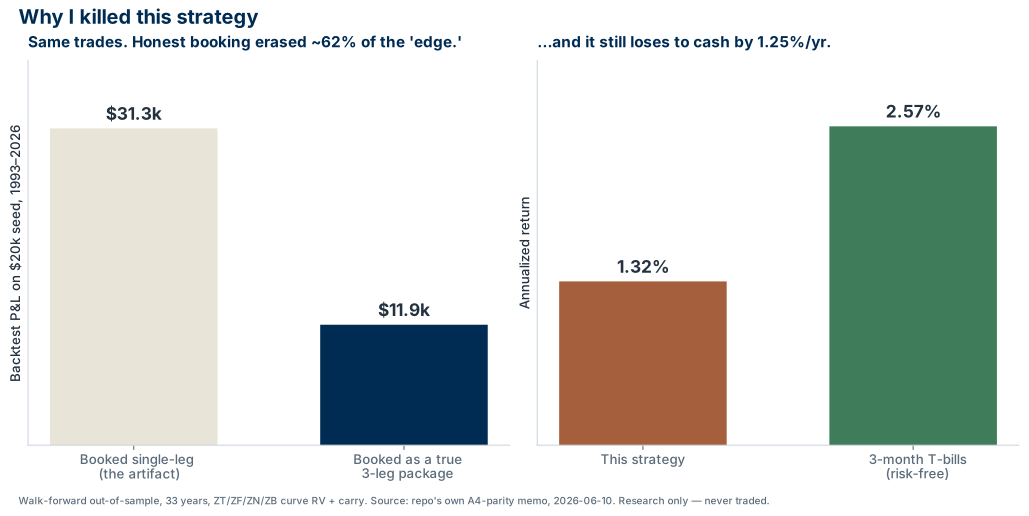
What remained was a strategy that returned about 1.32%/yr against T-bills at 2.57% — losing to cash by ~1.25%/yr — while still drawing down ~19% peak-to-trough, breaching its own risk budget once realistic slippage was applied. Several of the gating parameters were also partially fit to history, and the worst single regime was the 2022+ hiking cycle, i.e. the one most relevant to trading it today.
So I wrote it up honestly and shelved it. The repository’s own decision memo records the verdict: no deployable edge, research only, not promoted even to paper trading.
Impact
The deliverable here is not a money-making strategy — it’s a documented example of the standard I hold my own research to. Every claim above is traced to a file in the repo, the booking artifact is written down so I never repeat it, and the kill decision is logged with its reasoning rather than buried.
That discipline is the actual asset. In a private-capital practice where I’m allocating real capital, the ability to disprove my own thesis — quickly, in writing, before it costs anything — is worth far more than one more backtest that “works.” Showing the strategy I killed, and exactly why, is a more honest signal of how I operate than any equity curve I could put on a slide.